
The wonder of our free-to-enter sites
Cultural treasures build connections between our past and present. That’s why more than 300 English Heritage sites, such as the spectacular Hardknott Roman Fort, are free to all
Words Anna Crane
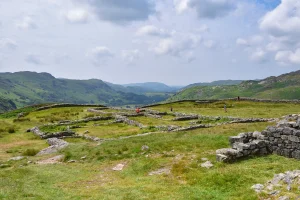
Huddled high up among the fells of Cumbria’s Lake District, Hardknott Roman Fort has a big impact on anyone tenacious enough to reach it.
It’s a favourite of Roman expert and curator of history Andrew Roberts. Every time Andrew visits, he can’t help wondering: ‘How on earth did they manage to build a fort up here?’ And, ‘What must they have thought of life in this remote spot, so far from Rome and the world?’
The fort, established early in the reign of Emperor Hadrian (AD 117-138), is squeezed into a spur jutting out above the Hardknott Pass, one of the steepest roads in Britain.
Because of the shape of the terrain, it’s formatted in a square rather than the usual rectangle, but although the archaeology is impressive (it has possibly the best-preserved Roman walls in Britain), it’s the views that inspire visitors most.
‘You look out over the Esk Valley, Scafell Pike and, on a clear day, all the way across the Irish Sea to the Isle of Man,’ says Andrew. When the sun is shining it’s a glorious place for a picnic.
Hardknott is one of more than 300 English Heritage sites that are free to enter. All over England, you can visit the scattered remains and reminders of people who came before us, from Neolithic stone circles to ruined castles, abbeys and country houses – without paying a penny.
‘Community support is key to a site’s safety and preservation’
Access to heritage
‘It’s important that most of our sites are free to enter,’ says national engagement lead Keith Bartlett. ‘Especially for the communities who live near them. Everyone should have access to their culture and heritage, and if we can open these sites up for everyone to enjoy, then hopefully people will appreciate their value and will want to look after them.’
Volunteer and engagement site co-ordinator Lauren Emslie knows that the Lake District community appreciates Hardknott.
‘At times, it can be challenging to get here as the road is sometimes closed,’ she says. ‘But we have no difficulty finding volunteers to help us look after this place – one of them walks up to check the site even in winter.’
And while you might think there couldn’t be much of a community in such an isolated spot, the pub landlords on the roads up to the site, the tenant farmers whose sheep keep the fort’s grass cropped and villagers down in the valley all help keep an eye on Hardknott, too.
Community support is key to a site’s safety and preservation. There are pieces of Hadrian’s Wall that sit amid Newcastle’s social housing estates and are proudly protected by residents.
In 2024, Reculver Towers in Kent, another free-to-enter site, reopened after a £1.2-million, four-year conservation project.
‘There were three-hour queues to get in and go up to the top,’ says Keith. ‘Some people had never been in before, even though they’d lived in the area their whole life. But they still felt they had a connection to it. We try to build on that.’
Free-to-enter sites are not, of course, free to maintain. It costs English Heritage £4.2 million a year just to keep them ticking over. And new research, excavation, information panels, safety measures and conservation all cost extra.
Revenue from membership and donations is vital to covering the costs involved in keeping free-to-enter sites open and accessible to all.
‘We’re seeing more and more people using our spaces and getting interested in heritage,’ says Keith. ‘They may visit these sites to walk their dog or have a picnic. Free sites are often the first step for people to find their interest in heritage and can be the inspiration to explore further.’