
See historic sites from new perspectives
Discover spectacular ceilings, vertiginous viewpoints and an underground trip back in time at English Heritage sites
Words Rick Jordan
The footbridge at Tintagel Castle
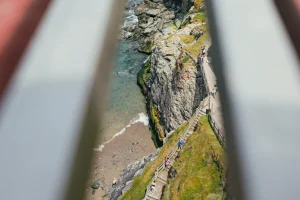
In north Cornwall, you can test your head for heights on a bridge that spans the two clifftops holding the ruins of Tintagel Castle.
The original land bridge had collapsed by the 17th century and the new link, built in 2019, connects the ruins for the first time in five centuries. The experience is as magical as anything Merlin conjured – the walkway has been crafted using Cornish slate, with raw oak handrails and balustrades so thin they seem to disappear into the air when viewed from afar.
The most spectacular point, though, is the 40mm gap in the middle where the two cantilevered sides meet: crouch here and peer down to see the sea crashing into the rocks 60 metres below. The bridge provides a thrilling path through a landscape awash with myths and legends.
With thanks to the Julia Rausing Trust for supporting the bridge’s construction.

Great Room, Archer Pavilion, Wrest Park
Popular with modern artists such as Banksy, the visual trickery of trompe l’oeil has been around for centuries. This painting technique creates the illusion of three dimensions, as beautifully captured at Bedfordshire’s Wrest Park.
Guests and visitors have been marvelling at the painted ceiling of the circular Archer Pavilion’s Great Room since the 18th century. High above, what seems to be a soaring dome ceiling is surrounded by sunken panels, statues, coats of arms and family portraits – but it’s all one painting.
The work of Mark Anthony Hauderoy, the ceiling is still startling more than two centuries later: walk clockwise around while gazing up and the effect is like a spinning carousel.
Mine shaft, Grime’s Graves
In a grassy moonscape pock-marked with the traces of Neolithic flint mines, you can journey back 4,500 years as you descend to the bottom of an ancient mineshaft.
Over the centuries, miners dug more than 400 shafts into the Norfolk chalk, using deer antlers to work down to the seam of jet-black flint they wanted. They used it to make knives, axes and arrowheads, as well as farming tools.
In 2024, English Heritage added a new entrance and ladder, improving visitor access. As you climb down nine metres through the chalk, narrow tunnels snake into the dark distance.
A new immersive film brings the miners to life – and the mineshaft is so well-preserved it’s as if they had only just put down their tools and left.
The oak roof of the Great Hall, Eltham Palace and Gardens
Built for Edward IV in the 1470s for court dining and entertainment, the Great Hall at Eltham Palace was a social showstopper of a venue. Its magnificent oak roof is a ‘false hammer-beam’ construction – the cross-hatch of hewn timber bristles with hammer-beams and wind braces, slotted together like an elaborate puzzle.
The hammer-beam design was developed by 15th-century Suffolk carpenters to allow for wide spans without central columns as support. The ‘false’ hammer-beam refers to decorative rather than structural use of the hammer-beams.
As you admire the craftsmanship, imagine the noise of the lavish Christmas feast held here in 1482 for 2,000 people.
Stained-glass windows, Chapter House, Westminster Abbey
The Chapter House of Westminster Abbey is a 13th-century octagonal marvel, but it’s the contemporary stained-glass windows above that really catch the eye.
After the windows were blasted out in the Blitz, they were reglazed by artist Joan Howson in the 1940s and early 1950s. Alongside salvaged panels are intricate designs of her own that show the wartime tenacity of the British people.
Look carefully to spot Spitfires locked in aerial combat, as well as telephone operators, the Home Guard, air-raid wardens and surgeons all hard at work.
Dungeons, Carlisle Castle
You can almost imagine a few bars of The Bonnie Banks of Loch Lomond floating up from the thick stone archways of the dungeons at medieval Carlisle Castle. It’s rumoured that this traditional Scottish folk song was written by Jacobite soldiers imprisoned here during Bonnie Prince Charlie’s ill-fated uprising of 1745-46.
Kept in the dark, the Jacobite prisoners had to lick moisture from the dank stone walls to stay alive and the grooves made by their tongues can still be seen in the limestone. Even on a sunny day, this chilling place will induce a shiver.